Showing posts with label Philip Larkin. Show all posts

Tuesday, 3 March 2015

As Bad as a Mile


Themes
Irrevocable failure, disappointment, punishment, human greed, temptation, desire to return to innocence

Content
On the surface, this short poem appears to be quite light-hearted, however, it can be seen to have a more pessimistic view. The idea of a person missing the "basket" with an apple core may not seem particularly insightful but Larkin makes the image take on a deeper meaning.

Analysis
  • The image of the "shied core" "skidding across the floor" after having missed the bin just barely is one that many people can relate to. It is an everyday failure that many people would place down to "luck", however, Larkin states that this shows "more and more of failure". This would seem  to suggest that faults are passed down from generation to generation but could also be implying that after so many failures in life, a person just sees life as a disappointment and blames what is purely luck upon themselves. The reader can empathise with the persona as there is that sense of frustration at being so close ("striking the basket") but yet still missing your goal.
  • "Failure spreading back up the arm" could relate to failures building up and consuming a person, until they become too fearful of failing that they don't wish to try anything anymore. The word "failure" is stressed through the use of enjambment.
  • Larkin laments the past,  a time when the "unraised hand" was "calm" and the persona did not know of the failure to come. Allegory is also used by Larkin in terms of the underlying story of Adam and Eve and the "apple unbitten"-the irreversible pinnacle of failure. The persona wishes to return to a time of innocence, before Adam and Eve took a bite of the forbidden apple from the Tree of Knowledge and forever corrupted the world. By eating the apple, Adam and Eve fell from innocence to awareness and thus, Larkin is suggesting that failure begins as soon as you become truly aware of the world.
  • However, there is also a message concerning human greed. The persona, like Adam and Eve, wanted too much. Whilst Adam and Eve had paradise yet still wanted the one thing not allowed, the persona had already had a bite of the apple and still wanted the victory of managing to throw it into the bin. People always want more and are bound to be disappointed at some point.
  • Therefore, perhaps Larkin is commenting on the fact that we can never return to innocence and that failure is irrevocable due to human greed and temptation.
  • The simple rhyme scheme of AAA in the first stanza and BBB in the second stanza make the poem appear almost child-like, emphasising the desire to return to innocence or it could simply be that Larkin is laughing at the ridiculousness of his thoughts. This would seem to be further proved by the title as the failure is exaggerated. The persona only just missed but Larkin makes the failure seem massive, as though they missed by a "mile".
Links to other poems
'Water'-a child-like way of dealing with important matters
'Love Songs in Age'-desire to return to a better time
'Afternoons', 'Talking in Bed'-disappointment due to your own choices
'The Large Cool Store'-human desire to always want to be better
'Sunny Prestatyn'- humans are innately destructive-destroy the best things
'An Arundel Tomb'-the past is always remembered
'Reference Back'-past events being painful to look back on

Link:http://enorfaslitionachampain.blogspot.co.uk/2014/04/as-bad-as-mile.html

Reference Back


Themes
Music, loss,  painful memories, separation, the onset of time.

Content
This poem is most likely based upon Larkin and his own mother, whom he visited regularly following his father's death. Through playing records in a separate room of his mother's house, mother and son connect over their joint losses-the memories of which are evoked by the music.


Analysis
  • The title of the poem is both a musical term and a reference to looking back on events of the past, thus connecting the past with music.
  • The poem begins with the mother commenting that the record previously played was "a pretty one".  The word "pretty" seems to be a less powerful adjective which suggests that while the mother was not particularly interested in the music, she wanted to appear so in order to connect with her son.
  • Repetition of the word "unsatisfactory" may be included to show that the speaker does not enjoy their time at home with their mother and believes it be "wasting" their time. In comparison, the speaker's mother obviously "Looked...forward" to the times that her son came over and this dichotomy of thought highlights the gap between the two people in terms of distance and feelings. There is little intimacy, with the son even staying in a separate room to his mother as a method of avoidance, perhaps because it was awkward and uncomfortable to be reminded of his dead father. The son derived little pleasure from the experience.
  • However, through playing such records as "Oliver's Riverside Blues", the persona is reminded of his youth and the time spent with his mother which he did not appreciate as much as he should have. A "sudden bridge" is made between mother and son as music helps them to reconnect but these memories are fleeting (like a "flock" of birds flying away). Larkin personally enjoyed listening to the jazz style of music that he makes reference to and at the time, it was new and radical-breaking down barriers and originating not from main culture. It was the first time that African-American music had become popular and it was a certain kind of soulful and truthful music.
  • At the end of the second stanza, the word "unsatisfactory" yet again appears to describe the mother's "unsatisfactory age" and son's "unsatisfactory prime". It would appear that no matter what a person's age, they will never be truly satisfied and there will always be something lacking from their life. Despite being in his "prime", the son is no more happy than his mother and it has been interpreted by some that this is because he feels guilty for his relative youth in comparison to his mother.
  • As is common in many of Larkin's poems, the poem switches from describing an everyday event to speaking in more philosophical terms, with the poem discarding the second-person pronouns such as "you" in order to become more universal. Larkin states that "our element is time" as we govern our lives according to time and age, however, we are "not suited to the long perspectives". We are not suited to the reflection that ordinary instances bring about as "they link us to our losses". Through music in particular, we remember that which is lost to us and by constantly delving into the past, we can never appreciate our present.
  • Our memories allow us to once again see ourselves in youth as "blindingly undiminished", with vast reserves of hope and vibrancy. Whilst our memories sometimes appear fresh in our minds, we have decayed and aged. Larkin consequently ends by questioning whether "By acting differently", we could have changed what happened in our lives and remained happy and vibrant- our life decisions have considerable impact upon us. However, the use of the qualifier "as though" and "could" implies that this would never have been possible.
  • Overall, Larkin is commenting on the breakdown of relationships and our bodies over time and therefore, how having long memories can be painful and depressing. We constantly question areas of the past which we might have done better and regret having not appreciated the time we did have. Even simple things such as a record can take us back to certain times which we now long for but cannot go back to-melancholy. On the other hand, some people often don't wish to revisit the past and want to stay firmly in the present.


Links to other poems
'Broadcast'-music and the idea of separation
'Love Songs in Age'-the link between music and memories, melancholy reflection on what was but has now decayed
'Nothing To Be Said'-how our life choices and reflection all bring us closer to death
'For Sidney Bechet'-jazz music as a method to allow reflection
'Dockery and Son', 'Self's the Man'-our choices determine the rest of our lives-regret
'Send No Money'-watching time pass and not appreciating it


Academic links: http://enlangjohnstoneh.blogspot.co.uk/2014/04/reference-back-by-phillip-larkin.html

Saturday, 28 February 2015

Home is so Sad


Themes
Attachment, loss, nostalgia and disappointment.

Content
Larkin is describing a "Home" which has come alive through anthropomorphism  and is "bereft" at having no people currently living within it. It is people that make a house a home and "Home" suggest a sense of belonging.

Analysis
  • The poem is simple and straightforward, with a lack of imagery and adjectives and an ABABA rhyme scheme to make the poem universal.
  • Larkin begins with the blunt statement that "Home is so sad", thus mirroring the title. This sadness can not only be related to the fact that there is currently no one in the house but also that homes can be disappointing and don't live up to expectations.
  • The "Home" itself has stayed loyal to its owners, with it still being"shaped to the comfort of the last to go" and trying to "win" the owners "back". It is unclear where exactly the owners have gone but it seems likely that they are away on holiday if they have left their belongings behind. The "Home" has an emotional response to these people and is trying to prove its worth but with each passing day, the house "withers" and breaks down without any human warmth. The register of loss progresses throughout the first stanza from "left" to "bereft" to "theft", each one a progressively greater violation (abandonment, bereavement, crime). The owners have been physically snatched away and the reader themselves feels the emotive loss of the house.
  • As is most often the case, Larkin has to include something critical and this comes in the form of the statement that homes are often filled with disappointment.  They are a "joyous shot at how things ought to be" which can never quite match up to expectations and have "Long fallen wide". People gain a sense of pride from owning a home which they can always return to but these homes are inevitably ruined by ill-feeling or do not match the life one expected for oneself.
  • The poem then returns to more tender images though which we envision the house as it "was"- the past. We are told to "Look" but cannot touch as the past cannot be returned to and the "Home" does not want any intrusion. The "pictures" and "the music in the piano stool" are all nostalgic and detail a person's life simply though the memories and events on show. However, the music which would have once been on show is now "in" the piano, highlighting that a lid has been shut on the past. The final line consists of only two words: "That vase." This simple item which means nothing to the reader has significant meaning to the homeowner as it contains endearing memories and stories. Flowers also connote joy and new life but Larkin builds a sombre atmosphere in that the items and memories are being remembered and thus, must have passed-resigned to the past evermore. The past is gone and cannot be returned to.
  • Therefore, "Home is so Sad" as it remains a frozen snapshot of how life once was and  is now, just as it was in the past, unable to live up to expectations.
Links to other poems
'Love Songs in Age'-nostalgia, disappointment at failed expectations, music as a source of memories, loss
'The Whitsun Weddings"- a promise (either marriage or home) that will ultimately fail
'For Sidney Bechet'-memories and the hope that they once held
'Afternoons'-decline and decay
'Mr Bleaney'- what makes and constitutes a home?

Academic links: http://enorfaslitionachampain.blogspot.co.uk/2014/03/home-is-so-sad.html


The Importance Of Elsewhere


Themes
Cultural identity, loneliness, isolation, tradition, the sense of being different and belonging.

Content
Before he came to Hull, Larkin worked in a library in Belfast, which is where the inspiration for this poem comes from. The poem explores how living away from your home country can make you at once feel both "lonely" and "welcome" as people understand it if you cannot fit in.

Analysis
  • 'Importance" suggests that something is needed or of significant value. By being "elsewhere", a person understands who they truly are but can also have some required time away from what is expected of them.
  • Though Larkin felt "lonely in Ireland" with nothing being familiar to him there, the "strangeness made sense". Through many of his poems, Larkin conveys the idea that he is different in views and life choices than others and by going elsewhere, no one questions these differences.
  • The "salt rebuff of speech" is describing the harsh Northern Irish accent and that though it may sound unwelcoming, the difference actually makes a person feel more "welcome". This is because your identity is reinforced and people understand that you won't have their accent or know their customs-sympathetic. For Larkin, it is a relief not be like everyone surrounding him and relationships can be built once the difference is "recognised". Within this first stanza, caesura appears to show the halting nature of life elsewhere and barriers must be dealt with, however, the soft 's' sound is also repeated to show how soothing that life can be.
  • Within the next stanza, Larkin goes on to describe Belfast using the various senses-sensory imagery. The "draughty-streets" and "smell of dockland" may not appear to be the most pleasant but perhaps Larkin is commenting on how we always compare our own country more favourably and that we often look on different things as being worse when this is not the case. This is summed up in the last line as the various sights show that Larkin is "separate" but "not unworkable". Difference does not mean exclusion.
  • Moving into the final stanza, Larkin describes life in his home country of England. The pronoun usage within the second and third stanzas augments the difference as Larkin describes "their streets" and "my customs". Though England is home, Larkin has no "excuse" for not fitting in as he knows the "establishments" and how he should act, therefore meaning that he cannot claim ignorance. If he were to "refuse" to adhere to custom, it would be much more frowned upon in England, with the end-stopped line showing that there is no alternative.
  • The final line is separated from the rest of the stanza by full-stops to emphasise the point Larkin is making. "Here no elsewhere underwrites my existence". In your own country, there is not another culture that governs you and allows you to be different, therefore making "elsewhere" seem sometimes more appealing. "Underwrites" is a legal term meaning to guarantee or confirm, suggesting that Larkin is ironically claiming that only "elsewhere" can he be confirmed of his existence and identity. Therefore, Larkin is implying that there are advantages to travel if a person wants to find themselves.
  • The lack of a rhyme scheme may suggest the disunity between the idea of "elsewhere" and home.
Links to other poems
'Here'- how loneliness can clarify a person's life-simpler
'Naturally the Foundation will Bear Your Expenses'-a more positive view of "elsewhere" than home
'Self's the Man'-is wanting to be different selfish?
'Talking in Bed'- how things you are accustomed to become stifling

Academic links:http://enorfaslitnaomilane.blogspot.co.uk/2014/03/the-importance-of-elsewhere.html, http://www.allinfo.org.uk/levelup/importanceelse.htm

Send No Money


Themes
Illusion and reality, disappointment, time, regret, aging.

Content
The poem is based upon a young boy asking personified "Time" to advise him on how to live his life. Instead of becoming an active participant, the persona simply observes the lives of others, however in the end, this cannot stop his own aging-"Time" has tricked him.

Analysis
  • Though the title may at first seem disparate from the rest of the poem, there are different interpretations of it.  The phrase 'Send No Money' was often used in adverts trying to cheat people out of their money by raising interest rates and thus, highlights how advertising can be deceptive. The imperative title may also be taken to mean that the persona needs no help or assistance as they are making their own way in the world.
  • From the start, didactic "Time" is personified to become a real entity with a "fobbed/Impendent belly"-time is always approaching and looms over everyone, not aesthetically pleasing. Larkin could also be implying that the persona is standing under an advertisement regarding time and looking for answers amongst a bed of deceit.
  • The persona eagerly demands that "Time" "tell " him "the truth" and "teach". There is no desire on the part of the persona to become actively involved in life and instead, they want to stand on the side lines. They believe that they know what they are doing and separate themselves from the "other boys" who wish to "have a bash". These boys want danger but exhilaration also and the sense of actually being alive.
  • "Time" is a frightening and condescending entity who observes from above-"he patted my head","booming Boy". He can be heard easily and is always present but untouchable.
  • The idea that the persona has "no green" in his eye suggests that he is not envious of those participating in life at the time as he only naively wishes to learn. The persona happily sits back as instructed to "watch the hail of occurrence clobber life out". Time is seen as a beating which increases in ferocity with every passing event, however, the persona gullibly believes that by simply taking a "look" and thanking "Time" for his advice, they can stay outside of the effects of time itself-child-like and simplistic.
  • By the start of the third stanza, "half life is over" as the persona has lived half of their life and must now meet "full face on" what has happened to them. The alliteration of "full face" emphasises the hard-hitting impact of what the persona sees- they too have been beaten up by time. Their "bestial visor" (animalistic mask) of a face is horrendous to the eye and unrecognisable-their aged self cannot comprehend the "bent in" (damaged) visage. They have been tricked by "Time" and have wasted a large part of their life to prove "Sod all". This cynical and bitter tone is still demanding answers which they have not gained through life and is reflecting on how the illusion of life, like advertisements, didn't live up to reality.
  • In the final two lines, the alliteration of the harsh 't' sound augments the bitter feelings of the persona and links all the words describing truth together. Larkin makes the poem take on a more philosophical aspect in stating that "truth" is "trite"(banal,insignificant), "untransferable" and a "Truss-advertisement". A "truss" is a form of medical implement used to hold organs in, thus linking reality and advertising and raising the question of whether reality stops advertisement from going too far or whether reality is held in by advertisement. The persona regrets that loss of time and was misguided into trying to search for truth when there isn't any. By rhyming "truth"and "youth", Larkin is suggesting that only in youth do we believe that we can find truth and that everything is a form of deception in the end.
  • The rhyme scheme of ABCDEFEF shows how people believe there to be so many possibilities within life in youth but come to discover that life is monotonous and normal as they age.
Links to other poems
'Sunny Prestatyn' and 'Essential Beauty'- advertising as deception and an attempt to hold in reality which ultimately fails.
'Ignorance'-people never really know the truth
'Dockery and Son'-how you spend your life
'The Large Cool Store'-life as a let down
'Days- nowhere to live outside of days
'Mr Bleaney'-having little to show of life


Academic Link:http://www.allinfo.org.uk/levelup/sendnomoney.htm

Thursday, 26 February 2015

The Large Cool Store


Themes
Class, illusions, clothes and fashion

Content
The poem describes a large store which sells cheap, slightly outdated clothes to those mostly of the working-class. Larkin clearly disapproves of the clothes and the people wearing them, who are trying to create the fantasy that they are a better person if they dress better and that they can have love through clothes.

Analysis
  • The title itself is ambiguous as the word "cool" could be taken to mean trendy and fashionable or that the store itself is cold and uninviting for people of Larkin's better taste. It is clear that Larkin looks down upon those of a lower class.
  • The fact that the clothes are "cheap" is good for those buying them as they cannot afford to spend considerable amounts and the "simple sizes" make the clothes "plainly" easy to find. However, these words also have negative connotations, suggesting that the people themselves are simple and plain and alliteration is used to reinforce the point that the clothes are not of good quality. There is no decoration or luxury.
  • Larkin then proceeds to list the different types of clothes which all seem the same to him, whether they are "Knitwear" for winter or "Summer Casuals" ,as they are all bleak "browns and greys". The work clothes are mundane, dark and sombre-horrible to look at.
  • From this, Larkin begins to imagine the people that wear them- the working-class who must rise at "dawn" to leave "low-terraced houses" (low in sense of physical position and status) for a day of hard work. Larkin appears snobbish and judgemental concerning those who work in the triadic list of "factory, yard and site". None of these destinations are appealing or attractive and so neither do the clothes need to be. For these reasons, Larkin describes the clothes as "heaps", suggesting that they have simply been thrown down without care or thought like a pile of rubbish-unpleasant.
  • However, these boring and plain clothes are then completely contrasted with the "Modes For Night", with the point being emphasised through the end-stopped line. These lingerie are designed to make a woman feel attractive and seductive, with vibrant colours such as "lemon" and "sapphire" drawing attention to the nightwear and making a woman appear exotic and self-assured at night. The contrast between night and day could not be so stark. Yet Larkin must underline that these clothes are "Machine-embroidered"- they are of no quality and just a façade, only an imitation.
  • "Baby-dolls" are fashionable and provocative bedclothes that flaunt a woman's shape and these clothes "flounce" in a girly attempt to attract attention in a frivolous manner. They are in "clusters" though, suggesting duplicates and imitation.
  • The women that wear the nightclothes believe that they "share that world" of fashion that the upper class occupy but the use of "their" shows that they are still separated/alienated. Larkin is perhaps also trying to come to terms with how two so different types of clothes can exist within the same place and be worn by the same class. The working-class want an escape and the women find that in fashionable lingerie.
  • Larkin then goes on to describe love and women as "separate and unearthly"-he (comically)does not understand the concepts and why people think that clothes make such a difference. Perhaps he is also hinting at the idea that women try so hard that they become unnatural. In youth, the "unreal wishes" of people mean that they cannot achieve what they desire but these wishes are also tacky and of no taste. Love and desires have become "synthetic, new and natureless". Larkin manages to make the neutral word "new" seem negative to imply that love is fake and cold-expectations are not met and people cannot just create the concept from clothes. However, they try to create the fantasy as it is the best that they have. Working-class society is one of impracticality and people trying to escape grim reality by wearing more fashionable clothes but ultimately, the fantasy disappears to reveal the fake nature of what people were trying to create.
  • The ABABA rhyme scheme links to the monotony and simplicity of the working-class and their lives.
Links to other poems
'Love Songs in Age'-love as a let down
'Faith Healing'-escapism
'Toads Revisited'-the tediousness of work life and its effect on people
'Sunny Prestatyn' and 'Essential Beauty'-aspirations being a deception, hopes destroyed, clothes as a form of advertisement which ultimately fail in their purpose, contrast of real life with dreams
'Afternoons'-condescending view of the working-class

Academic link:http://www.allinfo.org.uk/levelup/largecools.htm

Naturally the Foundation will Bear Your Expenses


Themes
Attitudes to war, academics, memorial days, class

Content
This poem should most certainly be read as a persona and not Larkin himself as the persona is clearly a well-travelled academic who is about to leave the country for Bombay, India. This person is controversially commenting on the service being carried out for Remembrance day and how he believes it to simply be a waste of time which has disrupted his journey. Larkin is commenting on the snobbery that surrounds the world of academia and their introspective lives.

Analysis
  • From the start of the poem, the persona is "hurrying" and too wrapped up in their own problems to pay attention to anything going on around them. The term "Comet" refers to the type of plane the persona is catching, thus instantly showing that this is a persona and not Larkin as Larkin disliked travel. The fact that they are travelling by plane and not train as in many of Larkin's other poems highlights how they look down on people and do not wish to be social or integrated into society-isolated. The use of the personal pronoun "me" reinforces their sense of self-worth.
  • The persona is travelling to"Bombay", the university of which will pay for their "expenses" in terms of travel and accommodation, as stated in the title. The speaker clearly believes this to be a point of pride in that they are so desired that institutions will pay to have them.
  • However, the paper that they are presenting is that which they first heard in "Berkeley"(a famous University in California). Clearly, this is an example of plagiarism and the persona is so desperate to be published that they will steal someone else's work. It is here that Larkin's clear dislike of academics appears as Larkin saw many snobby academics during his time as librarian at Hull University. 
  • The last two lines of the first stanza make reference to "Chatto"( a London publishing house) and "the Third" ( the most 'intellectual' station on BBC Radio 3). The persona is trying to show off their intellect but has no humanity or pity as the phrase "darkly/Through the mirror" shows. This is a reference to the Bible which highlights what the persona is lacking.
  • Moving into the second stanza the "Crowds, colourless and careworn" surround the persona, who is still disconnected from them. Larkin uses alliteration to suggest that the persona views the crowd as all the same and undeserving of attention. The only reason to notice them is the inconvenience they cause in making the "taxi late".
  • Only when the persona is "airborne" do they realise the importance of the date-they had forgotten that which it was inexcusable to forget and are disconnected from reality. The date is Remembrance Day and the time when the "Queen, Minister/And Band of Guards" have their remembrance ceremony at "Whitehall". It is here that the real controversy begins as the sibilance of "solemn-sinister" seems to suggest that the words are spat out in disgust and that the seriousness of the situation is glamourized- war is celebrated and the people who once made the decisions to send people to war are the ones mourning them (hypocritical), it is just an "act".
  • The persona even goes so far as to state that the ceremony is "wreath-rubbish". Such disrespect for the sacrifice of the soldiers is evident in this phrase and it appears that they believe the ceremony to be a waste of time. It's only significance is the delay it cost him. This point is further emphasised in the next line, which childishly exaggerates that the ceremony "used to make" the persona "throw up".
  • The word "mawkish" means overly sentimental and accuses the public of participating in a "nursery game" as the persona lacks the empathy to sympathise. The sarcasm expressed in "O When will England grow up?" deliberately invites criticism of the persona and shows how self-important they believe themselves to be. The sacrifice of millions means nothing to them.
  • Unlike the majority of Larkin's poems in this collection, this poem does not have a profound end as the persona simply flies away to meet his "pal" who "once met Morgen Forster". Even now, they cannot stop name-dropping and have no deeper thoughts or feelings, only a pretentious tone. Moreover, they are bitterly hypocritical as they continuously display egotism yet critique Remembrance Day for being too exaggerated and fake. Larkin is making us question the way different classes view war and highlighting that there are some people who are so self-absorbed that they do not care about historic events that deserve to be faithfully remembered.
  • The constant rhyme scheme of ABABCDCD gives the poem an energetic air, suggesting the pace of the persona but also making the poem harder to read at times-halting.

Links to other poems
'MCMXIV'- differing attitudes to war, one nostalgic and gentler whilst the other is cruel and vicious-indifferent
'The Whitsun Weddings'-the contrast between travelling by train and by plane
'Self's The Man'-sense of self-importance, every decision being selfish
'A Study Of Reading Habits'-dismissive tone

Academic Links:http://poetryandsuchlike.blogspot.co.uk/2014/03/naturally-foundation-will-bear-your.html, http://www.allinfo.org.uk/levelup/naturally.htm

Wednesday, 25 February 2015

Sunny Prestatyn


Themes
The difference between reality and advertising, the destructive nature of humanity, tainted innocence, feminism.

Content
This deliberately shocking and crude poem is based upon a poster for weekend holidays at the seaside, featuring women in provocative clothes and poses. These adverts were common during the 1950s and were seen as aspirational advertising due to also appealing to women who wanted to look like the pictures displayed. However, they were not accurate representations of the British seaside in any way, especially with regard to the climate. As the poem progresses, the poster is drawn upon and torn, until it is finally gone and replaced by another, more sombre poster.

Analysis
  • The title 'Sunny Prestatyn' gives the illusion that this Welsh area of Britain was hot and tropical when in reality, the British weather was anything but warm, thus immediately showing how deceptive the poster was.
  • The poster demands that people "come to" Prestatyn and reinforces this point with the image alongside the message, thus connecting the beautiful woman with the area of coast and drawing people in with false hopes. The fact that the "girl" is said as having "laughed" suggests a cheerful atmosphere, however, she is a "girl" and not a woman. She has not matured enough to deserve this status and Larkin is perhaps commenting on how women were exploited and led along like children. However, this could also be hinting at the idea of innocence, which is later reinforced when the colour "white" is used to describe the swimsuit-ironic as the woman is a symbol of sexuality, not purity.
  • The swimsuit that the woman wears is "tautened white satin"-luxurious and flattering to her figure. She is the presentation of perfection- an adult perfection which Larkin clearly appreciated.
  • In comparison to the woman, the actual area being advertised is simply a background image and described as a "hunk of coast". The word "hunk" is a pun with the duel meaning of being a chunk of something and the colloquial term for an attractive man, whilst also having negative connotations in terms of something be not well put together e.g. a hunk of metal.
  • The rest of the scene pales in comparison to the woman's "thighs" and "breast-lifting arms", which are the parts of the poster that draw the viewer's attention.
  • Moving into the second stanza, the poem becomes darker as the poster woman is "slapped up" on a wall-disrespected and degrading. The word "slapped" could be seen to link to 'slapper'-a prostitute who flaunts her body for admiration and payment. For all her beauty, she is placed without care-blackly comic.
  • The poster is defaced and the woman reduced to a "snaggle-toothed" face with "huge tits". She is simply a sexual object and the crude language used by Larkin is deliberately meant to startle the reader. The "huge tits" are in stark contrast to the "breast-lifting arms" described in stanza one due to the fact that those who have doodled on the poster have made the woman lesser than she once was.
  • The "tuberous cock and balls" that have been drawn on appear to be acts of violation and brutal abuse, as Larkin makes them seem, though the immature person who drew them is proud of their creation and has even "autographed" them.
  • This wanton destruction and violence escalates in stanza three, with a "knife" being used to "stab right through...her smile". Brutal reality is creeping in and people are trying to destroy this false perfection. Despite this, Larkin still looks on the woman sympathetically and states that "she was too good for this life", with "was" suggesting that she has passed. The full stops proceeding and following this line emphasise the point by cutting the sentence off from the rest of the stanza and showing that Larkin is perhaps displaying feminist views. He is mourning the loss of her innocence and perfection but is only doing so because of her sexual attraction. Eventually, a large "transverse tear" (alliteration showing the extent of the rip and hinting at a tear of sadness/mourning)  signals the end of the poster and it is removed.
  • The poem ends by switching to a much more serious tone with no trace of humour. In the place where the 'Sunny Prestatyn' poster once was is now a poster advertising the need for people to "Fight Cancer". The end-stopped line hints at the finality of the sentence and the reference to death but also how the idea of fighting a cancerous disease is more fitting for those who, as though possessed, have to destroy perfection. The idea of optimism vs pessimism and innocence being tainted is recurrent throughout the poem and this poster may last longer than its predecessor as it displays serious reality rather than deception. Contrastingly, another view is that the poster may have already been under the seaside poster, giving the sentence another meaning altogether and showing humanity's need to gloss over reality. Either way, once the beauty was gone, so was the value.
  • There are a number of points Larkin is perhaps making. One is that ultimately, people dislike being deceived and that reality will always conquer illusion. The idealised women is torn and broken until complete destroyed. Moreover, Larkin is also showing humanity's innate destructive nature in that some people cannot stand perfection and have to ruin innocence while other people simply want a break from reality but grim reality always prevails. Larkin uses nihilism throughout to show the rejection and lack of moral standards.
Links to other poems
'Essential Beauty'-mocking the media's fake portrayal of an idealistic society, illusion and reality
'Love Songs in Age'-illusions shattered and forgotten to be replaced by sombre nature of life, deceit
'A Study Of Reading Habits'-crude and colloquial language, dismissive
'Afternoons'-decay
'Take One Home for the Kiddies'-the cruel nature of humans
'Wild Oats'-Larkin admiring the sexually attractive woman
'Ignorance'-beliefs broken down

Academic link: http://www.allinfo.org.uk/levelup/sunnyp.htm


Tuesday, 24 February 2015

A Study Of Reading Habits


Themes
The division between fantasy and reality, escapism

Content
This ironic and laughable poem details the reading habits of Larkin, or perhaps simply a persona, as he grows up and progresses through life. It is whimsical and ridiculous in many ways as the speaker mocks what they once believed through stages of his life.

Voice/Register
An informal and humorous first person register is employed in order to give the poem a friendly, conversational feel but also to show that the poem shouldn't be take as serious and is just a trivial musing.

Analysis
    • In the youthful years of the speaker, books "cured" the boredom and monotony of life- they were an escape to a more exciting world and solved life's problems (except from school). From the start, colloquial language appears in the form of "getting my nose in a book" to cast a comic light on the serious-sounding nature of the title. The title shows that first looks can be deceiving,
    • A touch of bitterness appears when the speaker states that by reading they were "ruining their eyes" but at the time, they became part of the story. They imagined themselves as the hero, fighting for good against "dirty dogs". This slang expression and alliteration emphasises the hilarity of the image yet the speaker wanted to be strong and powerful- it is clear that they enjoyed reading exciting macho books.
    • As the speaker ages and becomes an adolescent, their desires also change. The comical "inch-thick specs" show that they can be self-deprecating and that physically, they could not match their illusions. They desire to become the anti-hero-the dark, seductive villain in a vampire novel and the fantasies start to involve women whom they "clubbed with sex". The line "evil was just my lark" plays on Larkin's last name, with "ripping" also being a play on words as it could be taken to mean having a good time or literally slashing something. An exclamation mark appears to highlight the power that they gained from reading-it was a seductive form of escapism.
    • However, these brooding fantasies are instantly dispelled with the last comedic line. The simile "I broke them up like meringues" suggests the fundamental harmlessness of the imaginings in that it does not take much to break a meringue. The contrast between the rhyme of "fangs" and "meringues" shows that the speaker can laugh at their own foolishness.
    • As time passes, things change and the poem brings us into the present. The speaker attempts to sound dismissive, using the line "don't read much now". This is because they now identify too much with the 'lame' characters- "the dude who lets the girl down" and the "yellow"(cowardly) man who "keeps the store". They no longer see themselves as heroic but rather, as the supporting/background characters who are unsuccessful. Brutal realism has struck and they are no longer under the delusion that books once offered as fantasy life is ineffective in shutting out reality. For this reason, the speaker becomes angry at the loss of this fantasy world and states that books can "get stewed" as they no longer have a purpose.
    • The end line ("Books are a load of crap") is deliberately shocking, particularly coming from a writer, as Larkin is ironically dismissing his own work and thus summing up the ridiculousness of the poem. The whole poem appears to be flippant and conversational, exploring the path that books lead us down and that ultimately, they cannot replace reality for a long period of time.
    • The rhyme scheme is that of ABCBAC to keep the poem simple and almost song-like, adding to its sense of meaningless and hilarity- a child-like tune.
Links to other poems
'Essential Beauty'- the difference between what is presented and what is real
'Sunny Prestatyn'- how fantasies are so easily dispelled
'Self's The Man'- flippant and child-like view of important issues
'Talking in Bed'-the breakdown of that which we once held dear
'Faith Healing'-believing in lies simply to make yourself feel better

Link:http://www.allinfo.org.uk/levelup/studyofreading.htm

MCMXIV

Themes
Sacrifice, loss, remembrance, innocence.

Content
 MCMXIV are the Roman numerals for they year 1914- the start of The Great War, which would later be named World War One. This poignant and melancholy poem concerns the queues of men lining up outside a recruiting depot to enlist in the Army and protect their country.

Analysis
The title itself is perhaps used for a number of reasons- not only does it inform us that the poem details the past but it also makes the reader work to figure out the meaning. Therefore, though the numbers are largely forgotten, Larkin makes the reader put more thought into the issue and reminds us of the war memorials of the time that were inscribed with these numerals.
  • The first stanza portrays the "long uneven lines" of men as waiting "patiently" and ironically,"grinning"- a feat perhaps only the British of the time could carry out. These masses of men are happily willing and eager and are expectant about that which is to come. It is as though they are simply queuing for a game at "Villa Park" as they are civilised and in no rush- the age of innocence. Larkin uses words such as "archaic" and "crowns" to describe the men, depicting them almost as ancient nobles and regal- Larkin understands the sacrifice they will make and is showing that he admires them as a type of royalty for their bravery-non-judgemental for once. However, the men themselves only see their actions as a game and do not understand the consequences. They act as though it is "an August Bank Holiday lark", with "lark" being a play on Larkin's name and showing them to be blissfully unaware that they will soon no longer be "grinning"- they see enlisting as a carefree adventure.
  • The second stanza moves on to highlight the world that the men are leaving behind. It is a world of peaceful games and everyday items such as "tin advertisements". Clearly, there is a touch of nostalgia as the old methods of payment like "farthings" are remembered, showing the passage of time since the event and many of the items are symbols of nationality, highlighting the patriotism at the time and perhaps that of Larkin himself. The shops themselves are likely shut because it is a public holiday, however, the pubs remain "wide open all day", welcoming men and offering support in the form of liquid courage with no licensing laws. The line "dark-clothed children at play" is perhaps a metaphor for war in that these innocents are wearing clothes typically associated with mourning and showing that innocence is forever lost by violence. Many men and even young boys who had lied about their age ended up dying in war areas and leaving their families behind.
  • The third stanza begins with the comment that the "countryside" doesn't care, thus perhaps being a use of anthropomorphism in that nature will not help in a battle of men or showing that those living in the countryside are so far removed that they do not care. Alternately, it could be taken to mean that the countryside has been abandoned by men leaving to fight and the place names forgotten as they are "hazed over" by overgrown "grasses"-unkempt, misleading. "Domesday" refers to the Domesday book which was a survey of all land owned in England. Larkin is perhaps criticising the wealthy who resided in the countryside in "huge houses" with "differently-dressed servants" for not fighting as it is the soldiers that deserve respect. The alliteration in these lines perhaps emphasises the mocking and judgemental tone Larkin adapts to refer to class and to point out that wealth pales in comparison to moral standards. The "restless silence "of the wheat (anthropomorphism) presents the anticipation and charged atmosphere that even nature displays, as though everything is waiting for this massive event to occur.
  • The final stanza clearly shows the lasting effect of war on Britain as the phrase "never such innocence" is repeated in order to highlight that war leaves scars and changes everything. There is a sense of finality yet the men at the time are still pure-hearted and unaware of the horrors to come. Caesura appears to show the peace before the true violence erupts, with men "leaving their gardens tidy", expecting to return and "the thousands of marriages, lasting a little while longer". This euphemism shows that the marriages still alive at that time were soon to be destroyed by death. Men expecting adventure were met with disappointment and Larkin critiques war for destroying this sense of innocence. The Great War destroyed social boundaries and changed everything Britain believed.
  • The poem itself is solemn and highly critical of war for its horrendous consequences, however, Larkin is not judgemental of the men signing up for what they believe will be a fun game. He respects these men and shows them as pure-hearted and brave, doing what they believe is right, even though others do not.
Links to other poems
'An Arundel Tomb'- not letting events or feelings be forgotten
'Afternoons'-normalcy and the passage of time
'Dockery and Son'-making important life decisions without full knowledge of the consequences
'Ambulances'-the inevitability of death
'For Sidney Bechet'-admiration and respect
'Nothing To Be Said'-how the topic of death is to some an unapproachable subject


Friday, 13 February 2015

Broadcast

Themes
The connection between music, love and separation
 
Context and Content
The poem is essentially a love poem concerning a male persona sitting at home listening to the concert that his love is at over the radio. It is based around a real event and was written by Larkin for Maeve Brennan after she was at a BBC Symphony Orchestra concert at Hull and Larkin was at home listening, trying to pick her out from the crowd. There are some slightly humorous elements such as the joke Larkin and Maeve Brennan shared about her "slightly-outmoded shoes", however, much of the poem seems to center around failed love.
 
Analysis
First Stanza-
  • The oxymoron of "giant whispering" suggests that the noise the persona hears over the radio is not easily distinguishable and that it is simply a blur. The auditory imagery of "whispering", "coughing" and "snivelling" (all onomatopoeic and some anthromorphism) presents an intense atmosphere in which sound is the only sense and Larkin was trying to decipher the sounds to find any linking to his love.
  • The metaphors of  "Sunday-full and organ-frowned-on spaces" depict the city hall as a church or perhaps shows the hall to have the atmosphere of solemnity that churches have. By using church imagery, Larkin is linking to the ideas of devotion and loyalty but also the idea of the tribulations that love can bring.
  • "The Queen" is a colloquial term referring to the national anthem, sung at any public event whilst the "huge resettling" is that of people sitting down after the national anthem has ended.
  • "A snivelling of the violins" depicts an image of sadness or sorrow, perhaps because the persona is intertwining his feelings of rejection with the sounds he is hearing.
  • At the end of this stanza, there is a sudden change of focus from the sounds being heard to the idea of a female love among the crowd, whom the persona is imagining. It is clear that this is real reason for the persona listening to the radio-to feel a closer connection to the woman. This sudden zoom into something clearly in focus shows the strong feelings of the persona and the wild landscape of his imagination.
 
Second Stanza
  • The caesura that appears at the end of the first stanza places emphasis upon the significance of the persona believing the women "beautiful and devout". However, an alternative interpretation is that is shows some bitterness on the part of the speaker as they are feeling rejected and rethinking what they believed "before". There is no suggestion throughout the poem that the speaker's feelings are reciprocated and the women is unresponsive. Larkin is trying to reach out but his love is drowning in the "cascades" of noise.
  • A paradox appears in that by mentioning the "unnoticed" glove, Larkin actually draws our attention to it. It becomes a particular point of interest which proves that he cares about her, unlike those others at the concert. However, he notices her but she does not notice him. By dropping the glove (a symbol of fidelity at the time), perhaps she is signalling the end of their love  or it could be that she is just a careless person.
  • The descriptions within this stanza are personal, as shown by the personal pronoun "your". The persona's thoughts have deviated from the music and become engrossed with the visualisation of what she may or may not be wearing-desperation. However, the description is also vague, meaning that the persona may not be as close to the women as he would like or her significance could be challenged.
  • When "it goes quickly dark", the phrase could be meant to show the persona becoming completely absorbed by his thoughts for her and only seeing the "outline" of reality. Contrastingly, it could show the speaker being abruptly pulled back to reality and seeing the truth before his eyes. The word "dark" could be a reference to his own life. Like the abruption transitions of a radio when you never know if you will lose signal, the persona's connection with reality fades in and out.
Third Stanza
  • Connotations of loss appear in the words "withering" and "half-empty", implying a negative view of love and suggesting that it may just drop away like the glove on the floor. There is only a tenuous connection which is fraught with uncertainty. The pathetic fallacy of autumn with the leaves falling away also hints at love ending.
  • The poem then returns to descriptions of the radio broadcast as it comes roaring back in as "storms of chording"-tumultuous-reflecting the Larkinesque character's feelings. He once again becomes caught up in it and is overpowered.
  • However, when the music is "cut-off", silence is left and the connection that the music brought is removed. The persona is left "desperate" to find even some sign of his love in the echoes, leaving his bare feelings on view. The poem ends with that tender image of "tiny" "hands" "applauding"-a gentle end to a loud and tumultuous  poem.
  • The rhyme scheme of ABACCB is constant throughout the poem, showing perhaps the unchanging nature of the persona's feelings and the connections that they attempt to create.
Links to other poems
'Wild Oats'- bad relationships, how Larkin goes for unattainable women, separation
'An Arundel Tomb'- romantic views of love, love connected with art forms, the contrast of being eternally close and separated
'Love Songs in Age'-music telling a story
'For Sidney Bechet'- music as a method of stimulating the imagination, fantasy and love

Links: http://www.cprw.com/philip-larkin-broadcast


Wednesday, 11 February 2015

For Sidney Bechet-group class work

For Sidney Bechet


Themes
Water, music and love- how all of these are intertwined and envisioned.


Content and Analysis
  • The poem was written about the famous Jazz composer Sidney Bechet, whom Larkin was a big fan of. Larkin actually worked as a jazz critic for The Times from 1961- 71 and greatly admired the effect that music could have on people.
  • The backdrop for the poem is New Orleans (the birth place of jazz) and there is a positive reflection on memories.
  • The poem is designed to have a jazz beat with an unusual rhyme scheme. The word "shakes" is placed at the end of the first line so as to stretch it out onto the next line. It is almost like a ripple on water.
  • "Like New Orleans reflected on the water" is a beautiful simile which presents the idea that music flows like water- "narrowing and rising". It adheres only to its own flow and rhythm.
  • "Appropriate falsehood wakes" in the ears of all those that listen as they get lost in the music and drift off into various day-dreams. Music is a form of advertisement and therefore Larkin is perhaps suggesting that this also is a "falsehood" and is only present for a time before leaving you in the real world again.
  • The poem operates on a system of cause and effect-the music causes people to imagine different scenarios. This may be the "legendary" French Quarter of New Orleans with its "balconies" and "flower-baskets" or the seedy underside. The second stanza focuses around "making love" and the romance that music can bring. There is a calm, relaxed atmosphere with music acting as a balm-soothing. As shown through the exclamation mark, people shout their appreciation of the music and are lifted up by it.
  • The poem then goes on to describe Storyville- the rough red-light district of New Orleans. The sounds of this area are muted by the sound of jazz music and  people group "around their chairs" just to listen to it. The government gave "license" for this area to engage in prostitution so as to limit prostitution to one area. The "sporting-house" girls are prostitutes who are likened to "circus tigers" (simile). They are still exotic and wild but are now tamed by the government (degrading view) and are under control-misogynistic. Yet they are still "priced far above rubies"-an offhand comment which refers to the Bible passage stating: "Who can find a virtuous woman? For her price is far above rubies." Larkin is mocking these women and the job they do.
  • Moving into the fourth stanza, the would-be scholars ("manqués) start to be described. These people have unfulfilled dreams and are passionate about music to make up for their lack of ability. The simile "like old plaids" is used to describe the audience and their anonymity or the fact that they are engrossed/interwoven into the music.
  • Unusually for a Larkin poem, the poem appears to be optimistic as Larkin describes his own connection to music, using the personal pronouns "my" and "me". He reacts to music as he believes others react when in "love", however, as he has not loved, he would not know. The caesura after "like an enormous yes" emphasises his love of music and the sense of affirmation it brings- everything is right in the world. "Crescent City" refers to New Orleans, which is the only place where Bechet's "speech" is understood fully.
  • The last two lines are more abstract, with music being the "natural noise of good" and understanding Larkin. "Long-haired grief" and "scored pity" are scattered around as the African American jazz music was notoriously sombre yet by spreading this grief, it appears that it is dispelled and people forget their problems. "Scored pity" is a pun on a musical score and refers to the pity we feel when listening to Sidney Bechet's work- the African Americans led tough lives.
  • The constant references to music (e.g."note","falls") give the poem a melodious quality and make people read it as though it were a song.
Links to other poems
'Love Songs in Age'- nostalgia, music and its relation to love and memories-contrast of love fading and music surviving but love remembered in music.
'An Arundel Tomb'- positive view on love and life, love lasting as a form of art e.g. sculptural
'Essential Beauty'- advertisements which seem to offer a better life but never last or cannot achieve what they promised. When the music stops, you are slammed back into reality-temporary diversion.
'Broadcast'- love connected with music-intertwined
'First Sight'- optimism of life, better things to come

    l

Faith Healing

Academic links: http://www.slideshare.net/30335/faith-healing-philip-larkin2-31036876

Saturday, 31 January 2015

Poems About Belief

Ignorance

Content
An abstract poem which explores our beliefs and knowledge.

Analysis
  • The word "ignorance" means a lack of knowledge, pig-headedness, stupidity or obliviousness. Larkin's poem questions whether we are all ignorant and of an uncaring nature and how uncertain people actually are throughout their lives.
  • The word "strange" is repeated to emphasise how odd it is that we claim to have so much knowledge yet actually "know nothing" and how complex the truth can be to understand. There are many different answers to questions, whether they be "true or right or real" and people are never certain "of what is true" as humans are constantly questioning themselves. However, this also highlights Larkin's uncertainty regarding the future and he wants people to question their beliefs.
  • Tentative phrasing appears at the end of the first stanza  (e.g. "it does seem so") to imply that people have to offer opinions or beliefs even when they know nothing, suggesting an element of stubbornness and pride. Larkin wishes to know the answers and states that "someone must know", however, this is perhaps just a lie people tell themselves to make themselves feel better or safer in the belief that the knowledge is out there.
  • Processes and objects are personified as adept at "finding what they need"- they are living reminders that we cannot understand everything. Alternatively, the "their" that Larkin refers to may be every other person looking for answers and simply learning to survive. The "spread of seed" is perhaps a reference to the spread of ideas or reproduction and people are willing to "change" what they believe as they are influenced by outside forces.
  • We "wear" our "knowledge" as a barrier to make ourselves feel secure and the "decisions" of our "flesh" (our actions)  make it seem like we know what we are doing. When people have strong beliefs, they flaunt them yet they are "imprecisions"- we base our lives so fully on things we often cannot prove.
  • Larkin creates a paradox in the last stanza in that we have "knowledge" but "no idea why". In the end, when death nears, we cannot fully understand death itself and why we had to create beliefs of no substance. As life draws to a close, we have no use for beliefs as the one truth is death . Therefore, Larkin may have meant to convey the idea that belief is futile as everyone claims to know something when they are in fact ignorant. People have learnt to survive by enclosing themselves in obliviousness and Larkin wishes to question this.
  • Beliefs are not truths but ideas we hold onto for security. They are easily subject to the influence of others. Larkin was ignorant of other's beliefs because they were not concrete. The last line highlights his view that there is no life after death, despite what others believe and Larkin questions whether people make the right life decisions.


Days

Content
'Days' is a philosophical poem about time and the meaning of life which concludes that the only answer to life is death.

Analysis
  • People's lives are governed and restricted by days of the year. Days are eternal, mundane and over-looked but at the same time, they offer us the chance for creating memories and happiness. They are a way of passing the time until death, as is a response to the opening question of the poem.
  • As Larkin states, days are "where we live". "Time and time over" the days are repeated and we are stuck in a constant cycle without any control. Days are personified as real living things which act as kidnappers of life and structure the way we go through daily routines.  However, at the end of the first stanza, the question arises of "Where can we live but days?". This is paradoxical as it would seem that the answer is nowhere- if days are life, we cannot "live" anywhere else. The only other alternative would seem to be death. This then is perhaps why the "priest and the doctor" come running as a person would be suicidal if they were trying to challenge beliefs and live outside of normal time or they would be considered insane. However, these two people also represent contrasting views-science and religion. Whilst the priest believes in afterlife and could offer prayers for a blessed life outside of days, the doctor would try to prolong the number of days you stay on earth. It is the thought behind the question and not the answer to the question itself that Larkin is emphasising.
  • The fact that the two men come "running over the fields" implies freedom and the natural cycle.
  • The poem is deliberately simple with no rhyme, simple language, simple answers and short sentences in order to have a sharp impact on the reader. It is almost childish in some ways, thus exploring a complex matter in a way that makes it seem less important. Larkin wishes to make us question even the simple things we know (or that we think we know). He tests all that we believe as routine and leaves us think this over.
  • Within the poem, there may be one or two voices. One interpretation could be that there is a questioner and the speaker who are having a conversation- this may even be a psychological review to test a person's sanity. Alternately, there may be just one voice who is questioning what they know about life. Days are a form of time and the way through which we organise our lives- without them, we would be lost.
  • The poem itself is particularly puzzling in that no clear answers are offered- it could be suggesting that we should live to the full while we have it or that death is the only solution to the endless days we have to endure.
Academic links: http://poetry-fromthehart.blogspot.co.uk/2014/07/days-philip-larkin.html


Nothing To Be Said

Content/Theme
A pessimistic poem about how death draws ever closer with every passing day, despite that which we do to deter it.

Analysis
  • Larkin starts the poem by describing different groups of people or places: "nations vague as weed" (an unflattering description of those developing countries), "nomads among stones" ( unattached and without a home), "small-statured... tribes" ( isolated with stunted growth) and "cobble-close families" (those people tied down in family life). No matter how different each of these groups are, they are all slowly dying. This paradox highlights that anything we do with our lives simply brings us one step closer to death. Alliteration could also appear to suggest the whispers of time and death that always surround us.
  • There are various different "ways of slow dying" that people use to pass the time, whether this be surrounding themselves with "benediction" or "measuring love and money". This juxtaposition of ideas presents both at materialistic and commercial. "The days spent hunting pig" are typical of the upper-class of the time and their differing ways of passing the days.
  • The "Hours giving...birth" imply that even those bringing new life into the world are just slowly dying and that though people may try to convince themselves that this new life signals hope, there is no way out of death. The phrase could alternatively be related to the superior profession of a doctor to emphasise that everyone, from every place, class and profession on Earth will die.
  • However, when people are told this, they are divided up into two groups. To "some" it "means nothing"- they do not care about death and want to simply take life as it is. To others, "it leaves nothing to be said"- this sums up everything that can be said and its traumatic nature robs the people of any words. There is no escape and they take this to heart.
  • The point Larkin is trying to make is that we spend our whole lives viewing other people differently and trying to prove that we are alive when actually we are just drawing closer to death, step by side. The fact that the poem title refers to the second type of people implies that Larkin himself belonged to that group and in many ways, feared death. 


Water

Content/ Theme
In many ways, this poem is a flippant musing on religion and Larkin's criticism of its ways. As an atheist, or more precisely, an agnostic, Larkin had no religion but did recognise that others found comfort in it. Larkin himself was unsure whether to believe in religion or not and therefore, this poem shows his uncertainties.


Analysis
  • "Water" is pure, simple, cleansing and life-giving. It is a necessity of life, which is why so many religions use it as a symbol.
  • Larkin starts by dismissively suggesting that he could "construct" a religion- a mocking view that suggests that religion is a mere fabrication and man-made concept that has little basis in the truth. Larkin wishes people to question their religious beliefs. He states that he would "make use of water" as it is transparent and has no hidden motives.
  • Numerous traditions of namely the Christian religion are mentioned, such as "going to church" and congregations, perhaps linking to the idea that many religions 'borrow' from one another and are ultimately the same. As the poem progresses, different uses of water are suggested. The "fording" makes reference to crossing a stream or river, implying that religion can be difficult whilst the "dry, different clothes" are hugely critical in that they relate to the stiff and artificial clothes people wear as their Sunday best. Religion has become too overcomplicated by things that are not needed and Larkin wishes to wash these things away. Moreover, the alliteration creates a sense of dullness and makes the reader dwell on the line as unlike the rest of the poem, there is not the gentle, lazy rhythm to mimic a river.
  • The imagery of water becomes more intense as the reader follows the stanzas, leading to a "furious devout drench"-Larkin is angry at the state of religion and wishes it to be cleansed thoroughly. It needs to return to the basics- the death of overcomplicated religions would be a good thing.
  • The last stanza focuses on raising a "glass of water" in the "east" as may religions originate from the East and this is where the sun rises to begin a new day. However, it could be interpreted as a mocking gesture, laughing at the absurdity of religion with a "cheers". Where this glass is lifted, "any-angled light would congregate", a simple idea that includes both science and religion. While science often seems to contradict religion, the word "congregate" suggests that religion and science could co-exist peacefully-a positive and optimistic end note.
  • The poem as a whole has no rhyme scheme and enjambment to keep it simple with no exaggeration.
  • The first person voice is used to make the persona appear god-like and egotistical.
  • Larkin manages to question religion in just 13 lines, making the poem whimsical in many ways yet at the heart of the poem is a paradox. Larkin seems to criticise religion  yet at the same time suggests creating a religion himself and acknowledges that religion cannot be dismissed for it brings comfort to many. He wants religion to remain, just in a purer form.

Academic link: http://theviewfromoutside.com/2012/09/17/written-analysis-of-a-poem-water-by-philip-larkin/


First Sight

Content/Theme
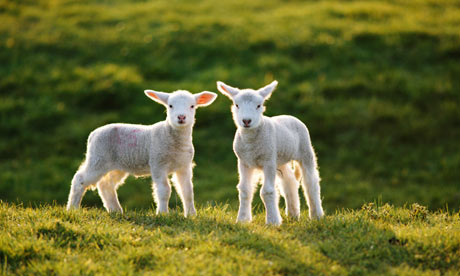
An optimistic poem concerning the passage of the time and the changing of seasons, as based around lambs taking their first steps into the world.

Analysis
  • 'First Sight' refers literally to the lambs' first sight of the world as they are born. It is a hopeful and positive time.
  • The lambs are symbolic of youth and innocence and have many opportunities ahead of them. Though they are "stumbling" and lost, they will gradually learn the necessary skills and find their way. However, they are born into winter (the season of death), which Larkin describes using negative imagery. The oxymoron of "sunless glare" emphasises that the cold is chilling to the bone and that there is no sun to warm the lambs as they adapt. They are born into a harsh and unforgiving season- "unwelcome".
  • Despite this initial bleakness, there is a sense of anticipation in the second stanza as the lambs "wait" for something that they perhaps can sense will come. "Earth's immeasurable surprise" is the changing of the seasons from, in this case, winter to spring. Whilst the lambs may not be able to "grasp" what is to come, a surprise has positive connotations and suggests that they will soon receive a gift. "Utterly unlike the snow", spring brings with it light and hope.
  • As a whole, the poem is oddly positive and hopeful for Larkin, with the depressively bleak winter landscape being contrasted with the prospect of forthcoming winter that is to unfold. Larkin is suggesting that though life may appear bad at times, there is always hope and things are not as bad as they seem.
  • The rhyme scheme of ABABACC is somewhat melodious and the rhyme at the end suggests optimism and serenity.
  • Despite this, many would like to think that there elements of pessimism in the poem and that the surprise is death. After all, lambs are bred to be eaten and surprises are not always welcome. The image of the ewe "caked" in mud/snow is strongly negative and suggests that the lambs too will be soiled by their harsh lives, however, I would take the poem at face value.
Academic link: http://www.uni-koeln.de/phil-fak/englisch/larkin.html


Links
Days, Nothing To Be Said- occupy our time to distract us, all drawing closer to death
Days, Toads Revisited- better to do something with your time
Ignorance, First Sight- lack of knowledge about what is to come, contrast- can be a positive, hopeful future
Ignorance, Water- overcomplicating life, wanting something to believe in

Overall
Larkin understood that people wanted security in their beliefs yet he forces them to question this. He himself was uncertain about what he believed in and was searching for answers just like so many others, hoping for a positive future like that in 'First Sight'. He knew that beliefs could be comforting but he did not want to believe in something fake, overcomplicated or untrue.